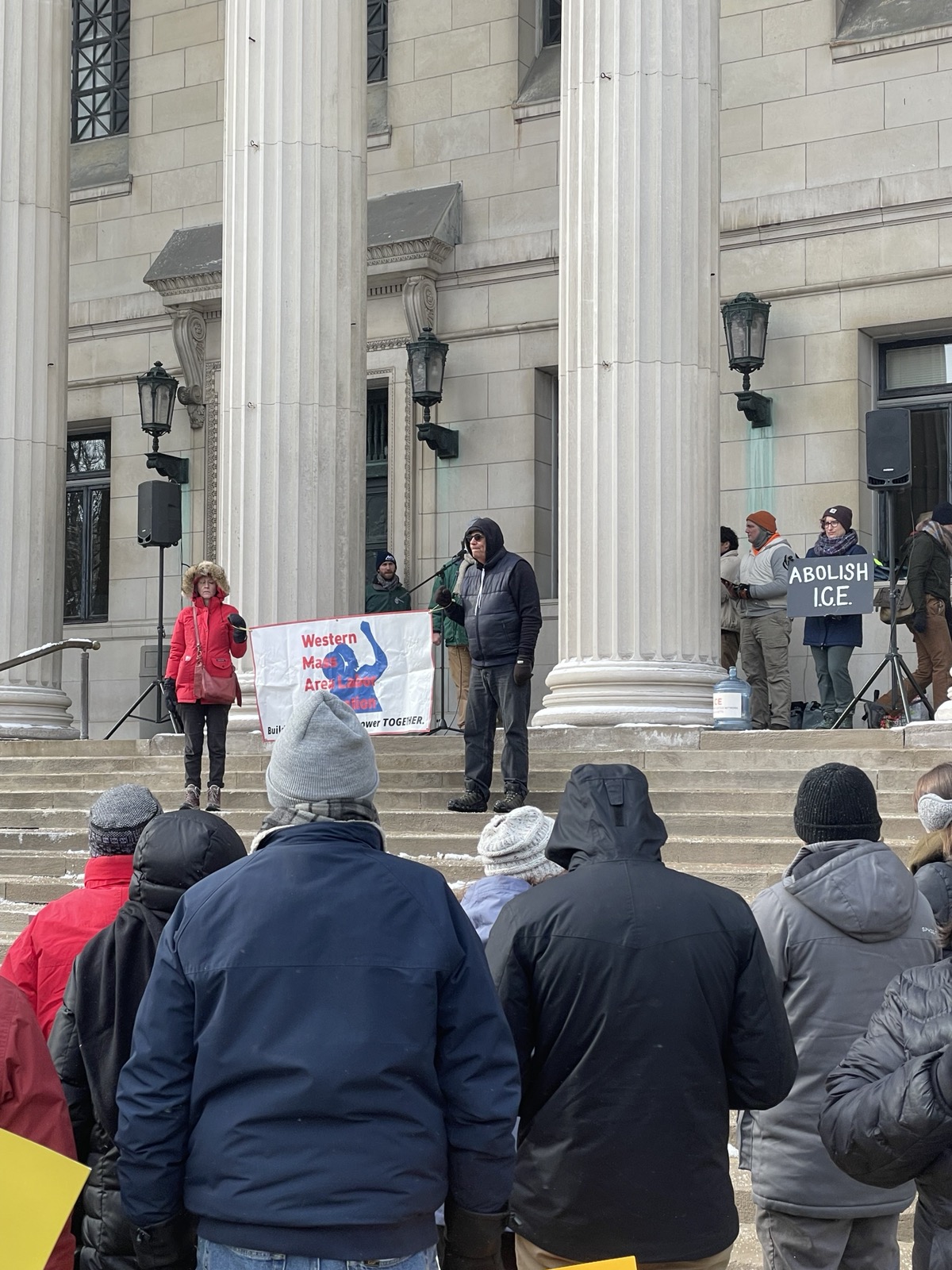
At 1:00pm on February 7th, 2026, 200 people gathered in a rally against ICE on the steps of the Springfield Federal Courthouse. Organized by the Western Massachusetts Area Labor Federation (WMALF), this rally, entitled "Working People Against ICE", hosted speakers from a multitude of unions and community organizations, as well as intermissions for music and popular collective chants such as "¡El pueblo unido, jamás será vencido!". This rally did not only serve as a call to action for the people, but as a message to state and federal legislators, with the WMALF expressing three demands:
- Not only must future contracts be prohibited, end all existing 287(g) agreements between ICE and the Massachusetts Department of Corrections. (287(g) agreements allow state and local officials to be deputized as ICE agents.)
- Mandate virtual access to all Massachusetts court hearings through new legislation and changes to Massachusetts Trial Court Policy so individuals can participate in court proceedings free from ICE presence and intimidation.
- Pass the Dignity not Deportations Act to end and prohibit future 287(g) and IGSA contracts in Massachusetts. (The Dignity not Deportations Act, if passed, would prohibit Massachusetts state officials from voluntarily aiding ICE.)
The President of the WMALF stated at the beginning of the rally, "not only do we need Homeland Security defunded, we need ICE abolished. If the Democratic Party can not deliver, they need to get out of the way".
Endorsements for this rally were numerous, with the co-sponsoring unions including Amherst Pelham Education Association, Holyoke Teachers Association, IATSE Local 232, Mass Nurses Association, Mass Society of Professors, Northampton Association of School Employees, SEIU Local 509 and 1199, and Springfield Education Association.* Notable endorsements and presence by political community organizations included LUCE, Pioneer Valley Workers Center, River Valley DSA, Arise of Social Justice, River Valley PSL, Veterans For Peace, Rise UP Western Mass Indivisible, and Out Now Springfield. Out of the many endorsing unions, membership in Western Massachusetts specific unions number at least 4,000.**
The politics espoused by many of the speakers, especially union speakers, were incredibly advocative of independent grassroots organizing by working people. The rally was, after all, called “Working People Against ICE”. This rhetoric demonstrates that, despite many appeals to the legislature, there is a public sentiment that is increasingly moving away from begging politicians to act in line with their constituents, and towards independent organizing.
Notable points made by union speakers include that of an organizer with the Springfield Education Association, stating "your ability to protect your neighbors, comes from your capacity to organize...the predominant mode of protest that Americans are used to is that of appeal to elected officials or to management, and we are seeing that this is entirely shallow in comparison to what we've seen in Minnesota, which is direct, organized action, by workers, by educators, by students, by neighbors for neighbors." A union speaker from the SEIU Local 509 and member of the River Valley DSA, declared "...let's not be mistaken, the same systems that have been locking up Black and Brown US citizens, are the same systems locking up immigrants. And for what? Profit." A member of the Holyoke Teachers Association said: "...the general strike attempt in Minneapolis was a good start. We need to be taking that energy across the country...in order for society to run, the working class needs to consent with our labor. We are the ones that make society run, if we choose to stop, society stops... [There was] bipartisan support for the homeland security act of 2002... which originally created ICE. The working class needs its own party, the working class needs independent action...".
Rallies like these are incredibly important as a rallying cry for organizers, as well as acting as a way to build solidarity and lift the spirits of the audience, which all rallies should strive to accomplish. With a relatively low turnout compared to the number of workers and activists that the endorsing unions and organizations represent, it raises the question of how we can mobilize the union workers we need for the work stoppages these labor leaders proposed. Despite the impressive number of local unions endorsing the rally, the crowd consisted largely of political organizers, members of endorsing political parties, and union staffers, rather than rank and file workers and yet-to-be politicized folk. This is partially exemplified by the official focus of the rally being demands for state and federal officials to pass legislation. Historically, legislation such as that demanded by the WMALF has acted, at best, as a band-aid to a symptom that finds its progenitor to be a far more encompassing issue than policies can solve. Besides energizing the people, a rally must in simpatico strive to politicize folks, and create a large base of connection between workers and students in different workplaces and campuses. Without this, movements of any kind become infinitely harder to build.
* Other endorsing unions include: Springfield Federation of Paraprofessionals, UAW Local 2322, UFCW Local 1459, and UNITE-HERE New England Joint Board.
** These unions are Springfield Federation of Paraprofessionals, Amherst Pelham Education Association, Mass Society of Professors, Northampton Association of School Employees, and Springfield Education Association.
Comments