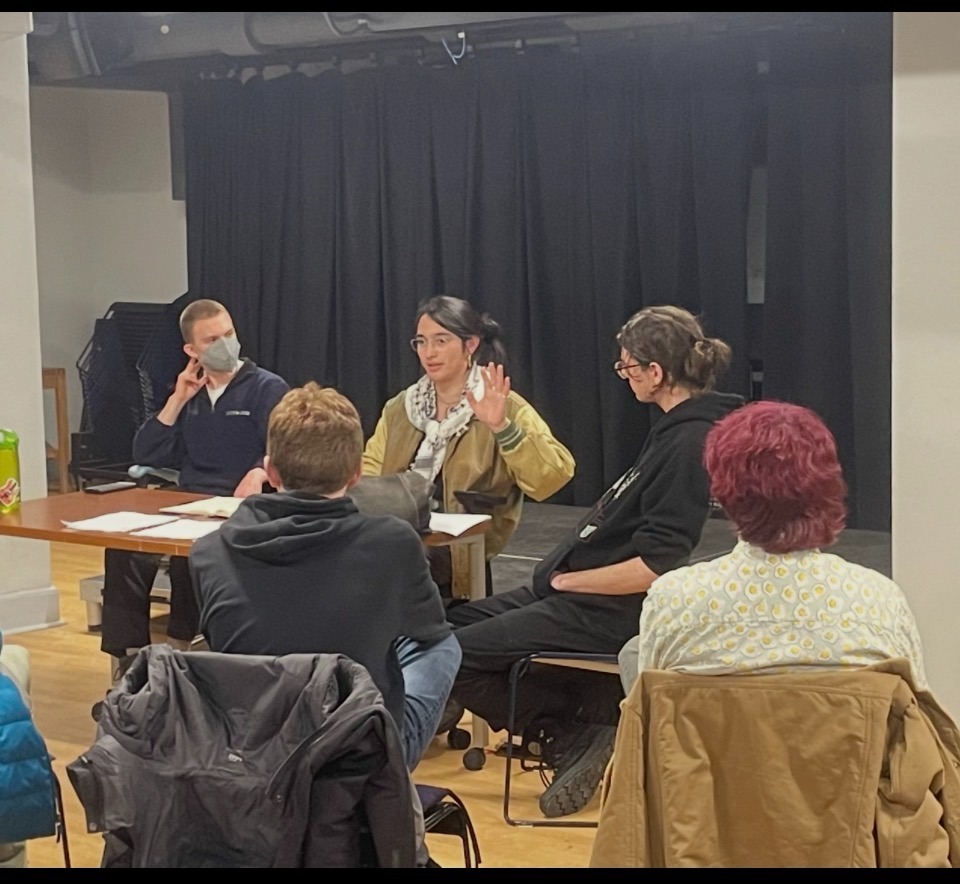
On Feb 25, UMass Amherst Young Socialists hosted a public meeting discussing the U.S. intervention in Venezuela and the policy of imperialism being renewed against Latin America. Introductory remarks were given by Rosa Pepper-Macias, rank and file worker of Unite Here Local 217 and member of La Voz de los Trabajadores/Workers Voice.
Hands off Venezuela
Beginning the discussion, Pepper-Macias spoke on the root causes of imperialism, citing the necessity for capitalism to expand to new markets in order to counter the falling rate of profit domestically. Referring to imperialism in the Americas specifically, Pepper-Macias gave background on the Monroe Doctrine. This 1823 policy position declared that the United States would oppose European colonization of the Americas and that the United States would be the sole regional power. With the aim of preserving both national and capital interests, the U.S. waged wars, overthrew governments countless times, and committed corporate-sponsored massacres across the continents. This overt aggression was a staple for the United States until the 1930s, when imperialist projects by the U.S. were framed more as economic and political partnerships compared to the public barbarism of previous decades. Today, Donald Trump's administration aspires to a revival of such aggressive foreign policy, in what has been dubbed the 'Donroe Doctrine'. The administration's recent aggressive actions against the sovereignty of Venezuela, Cuba, and many others across the globe have demonstrated a stark shift towards overt shows of force in comparison to recent administrations. This new offensive, under the all-too-quickly dropped guise of defense against narcoterrorism, again harkens back to a U.S. control over 'their own backyard'. As Chinese imperialism takes growing steps to challenge the U.S. global hegemony, the U.S. is afraid of China's influence in Latin America. One of the first economic moves of the new U.S.-controlled Venezuelan leadership was ending all oil trade with China.
No Confidence in the Chavista Forces
In the face of the threat of American imperialism, the ostensibly socialist government of Venezuela has failed in defending against exploitation of their industry and has done an abysmal job in securing welfare for its citizens. Ever since Hugo Chávez took power, the government has made a fundamental error in simply utilizing the existing state apparatus rather than transferring power to the many independent worker's organizations that existed before Chávez’s state repressed them to the fringes of society. The Venezuelan government has failed to defend against the incursions of capitalist markets by continually allowing the privatization of the state's oil industries. This government has made the situation worse by jailing labor leaders and disrupting grassroots organizing, especially those in opposition to Maduro. Rather than taking an internationalist standpoint, Chávez and Maduro's governments have opted to build socialism in one country and have done little to support revolution abroad. As a result, Venezuela has found itself without allies and shut out from the global market despite continual capitulation to imperialism. The resulting situation has been devastating for the people, who are antagonized by both the state and foreign capital interests. Rosa detailed that 8 million Venezuelans relied on humanitarian aid in 2025, and that many who attempt to escape to other countries find themselves enduring low pay and inhumane treatment in sex work or other abusive industries. If Venezuela is to solve their crises and resist foreign aggression, it must embrace an internationalist perspective, fulfill the promise of empowering the working class and create a society which can truly stand as an independent alternative to global capitalism.
Building a Working Class Response
As U.S. Imperialism continues to violently reassert itself across the world (currently also bombing Iran and strangling Cuba) the American working class must link itself to the fights for the self-determination of the working people of Venezuela and other U.S. targets. The people of Venezuela are the strongest force for rejecting imperialism within their own country and must be supported to put up that fight. American workers need to support the right for Venezuelans to organize their own country and oppose U.S. intervention that overrides the needs of the Venezuelan people for U.S. oil interests. American workers and students should organize mass mobilizations that build local consciousness of the issues at hand, bringing in broad layers of American society to oppose all assaults on other countries.
Comments